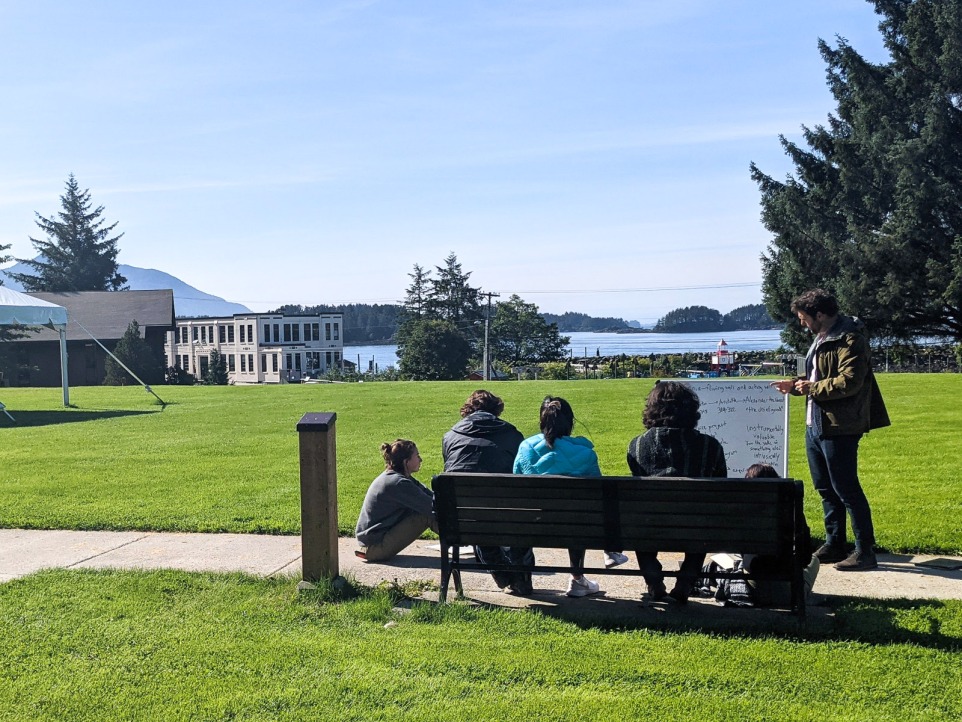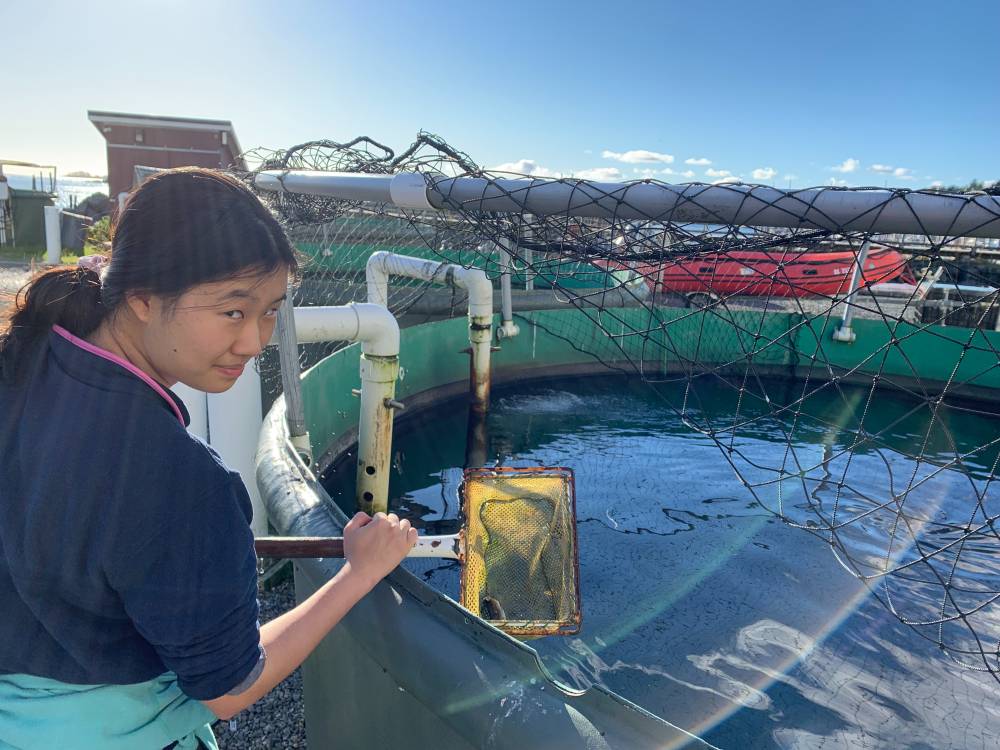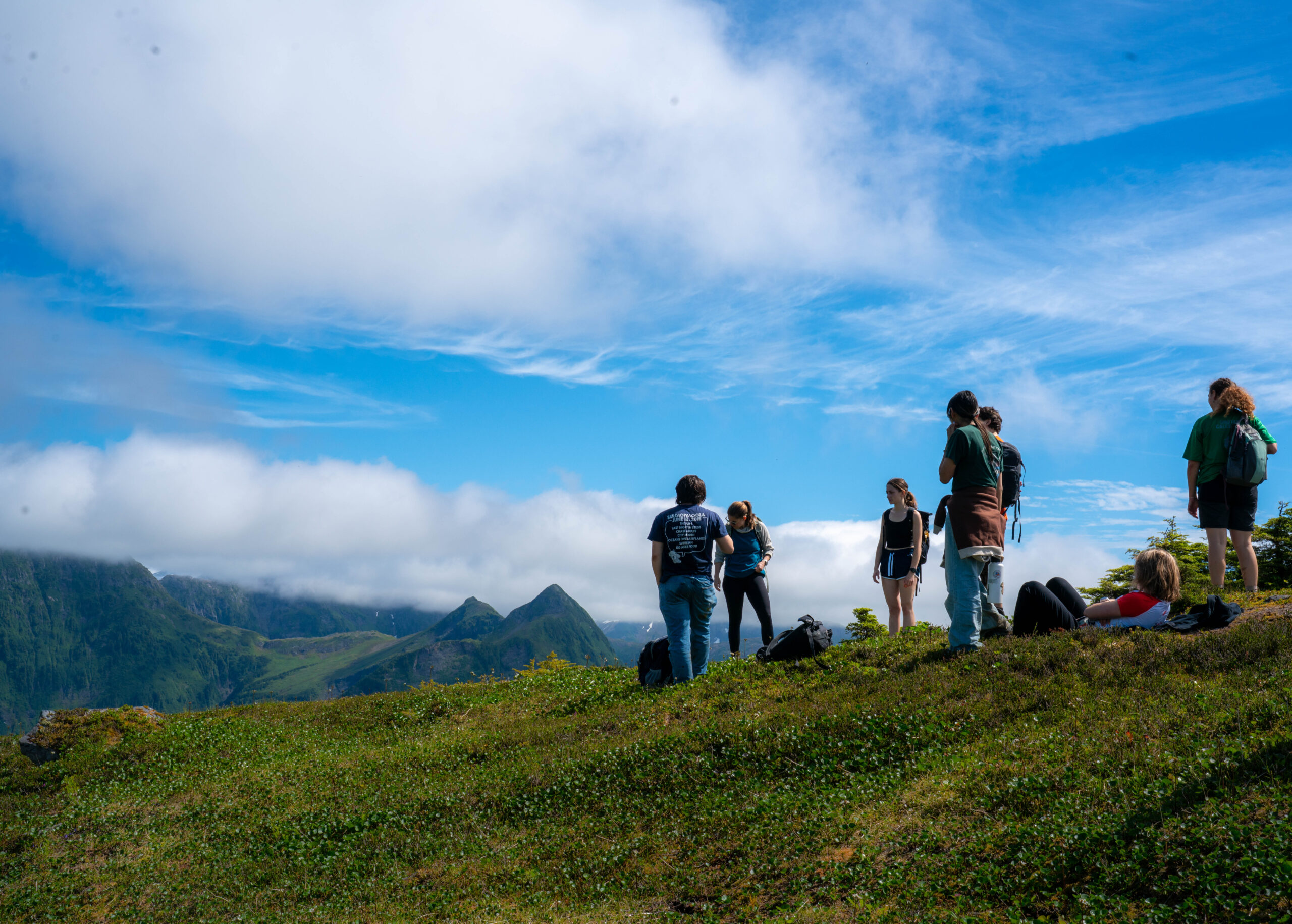
The Summer Seminar is an immersive opportunity for rising high school juniors and seniors to get a taste of the college experience – and shape it for themselves.
Over the course of an intensive Summer Seminar, a cohort of students undertake fast-paced, intellectually rigorous academic coursework; engage in work-based service and meaningful labor in Sitka; and practice self-governance of key elements of Outer Coast. Through a small seminar, close-knit residential living, and involvement in the wider Sitka community, Outer Coast students learn how to identify, analyze, and address the challenges – both big and small – that face the world today. Rising high school juniors and seniors participate alongside high school graduates and build mutually beneficial near-peer mentorship bonds.
In the fast-paced Summer Seminar environment, students engage in college-level academics, practice the mechanics of making change, and build meaningful relationships as part of an intentional learning community.
The Summer Seminar 2026 will run July 12 – August 1, 2026. The application opens January 1, 2026, and the deadline to apply is March 1, 2026. For more program details, see the Program Overview.
Summer Seminar 2026 Courses
The Arts of Noticing in Multispecies Worlds
Eben Kirksey
Passionate immersion in the lives of fungi, microorganisms, animals, and plants is opening up new understandings, relationships, and practices of care. Students in this course will experiment with new ways of engaging with creatures in shared ecological communities. Anna Tsing first described the “Arts of Noticing” as a practice for recognizing life forms that are proliferating in patchy landscapes that have been transformed by extractive capitalism and colonial empires. In the Anthropocene, the era when human agency has been scaled up to embrace and endanger planetary ecologies, learning how to notice other creatures could become integral to collaborative survival. Theoretically this course will depart from recent scholarship in multispecies studies, a field that considers how a host of organisms are linked to human social worlds. Taking inspiration from the recent work of Donna Haraway, we will consider new kinds of relations emerging between people and other species that involve symbiotic associations and the mingling of creative agents. Together we will ask what is at stake – ethically, politically, and epistemologically – in noticing and being attentive to diverse ways of life.
Traveling beyond the bounds of the conventional classroom – by foot and by boat – we will venture into multispecies contact zones, which are spaces where species meet. The art of noticing other creatures involves taking good field notes, which are written inscriptions and descriptions. Multi-media, multi-modal, and practice-based artistic methods will also inform our approaches. Students will have the opportunity to make aesthetic interventions that bring attention to whales, worms, and unloved others. Learning how to responsibly care for others is integral to the arts of noticing in multispecies worlds. Visits from Indigenous scholars and leaders will situate the arts of noticing within specific cultural practices.
Making Place: Design, Repair, and Belonging in Sitka
Todd Erlandson
This seminar explores how careful observation, making, and everyday practices of repair can shape belonging in a specific place. Using Sitka as our classroom, students will investigate how everyday environments – paths, thresholds, gathering edges, informal shelters, signage, and improvised repairs – support or hinder connection, orientation, and care. The course treats design not as a professional discipline, but as a shared set of tools for understanding and responding responsibly to place, and is designed to sit alongside and complement other Summer Seminar courses through shared themes of agency, service, and stewardship.
The course begins with a period of guided wandering, inspired by the dérive: a slow, attentive movement through place that prioritizes noticing over efficiency. In coordination with Outer Coast staff and faculty, we will identify a focused area within Sitka. Students will walk, observe, and document without an agenda beyond paying attention—mapping movement, light, sound, weather, use patterns, and moments of friction or delight. This process will include sketching, photography, writing, and diagramming to translate lived experience into 2D representations. Alongside observation, students will learn how to ask questions and gather information respectfully. With guidance from the Outer Coast community, we will identify ways to engage with Sitka residents—through informal conversations, interviews, shared activities, or existing community resources. The emphasis is on listening and learning quickly without extraction, and on understanding how people already adapt, maintain, and care for the places they inhabit. Students will work in small teams and play an active role in shaping the direction of the seminar. Early on, each team will develop a shared project question—such as how people find their way, where informal gathering occurs, how seasonal conditions shape use, or how everyday acts of care and repair are carried out. Teams will write a short project charter outlining responsibilities, decision-making processes, and values, reinforcing the course’s emphasis on self-governance and collective accountability.
The second half of the course focuses on testing ideas through making. Teams will develop responses that may include small prototypes, temporary installations, 2-D artifacts (maps, drawings, diagrams, or printed matter), or participatory actions such as events, prompts, or low-key campaigns. These responses are intended to clarify, reveal, or gently resolve conditions observed earlier, rather than to “fix” them. The emphasis is on experimentation rather than permanence: build, observe, revise.
The seminar concludes with a public-facing exhibit and presentation that brings together physical artifacts, drawings, documentation, and reflections. This final sharing may be coordinated with other Summer Seminar courses as appropriate, allowing students to see connections between different lines of inquiry while retaining ownership of their own work. No prior design experience is required—only curiosity, care, and a willingness to learn through doing.
Summer Seminar 2026 Faculty
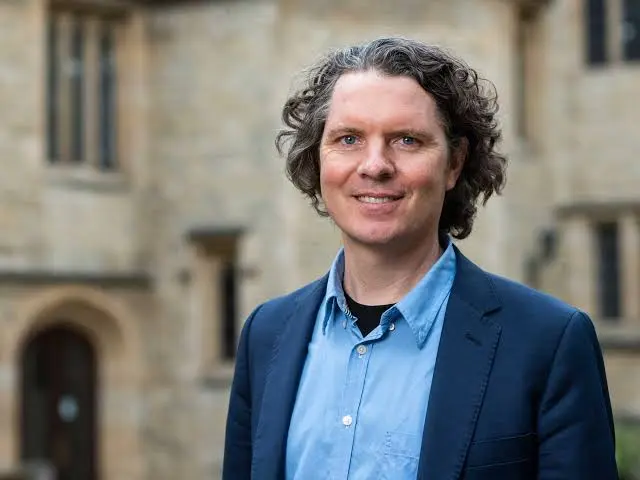
Eben Kirksey
Eben Kirksey is Professor of Anthropology at the University of Oxford and an award-winning author. Broadly speaking, his research and teaching relates to nature, culture, and the politics of imagination. He best known for his work in multispecies ethnography – an emerging field that considers how people interact with animals, microbes, plants, and fungi. Wide ranging interests – related to novel ecosystems, environmental art, social movements, Indigenous politics, biotechnology, and disability – are reflected in his diverse publications. His latest book, Symbiotic, is forthcoming with Princeton University Press in 2027. Hope is a recurring theme in his work: not as naive optimism, but as a method for identifying fragile possibilities for life and peaceful coexistence. Previously he has taught at Deep Springs College, Princeton University, and New College of Florida. He worked as a kayak instructor at Outer Quest in Santa Cruz, California, and also an Instructor for the Outward Bound Florida Programs. As a thru-hiker he walked the John Muir Trail and 1,200 miles of the Appalachian Trail.
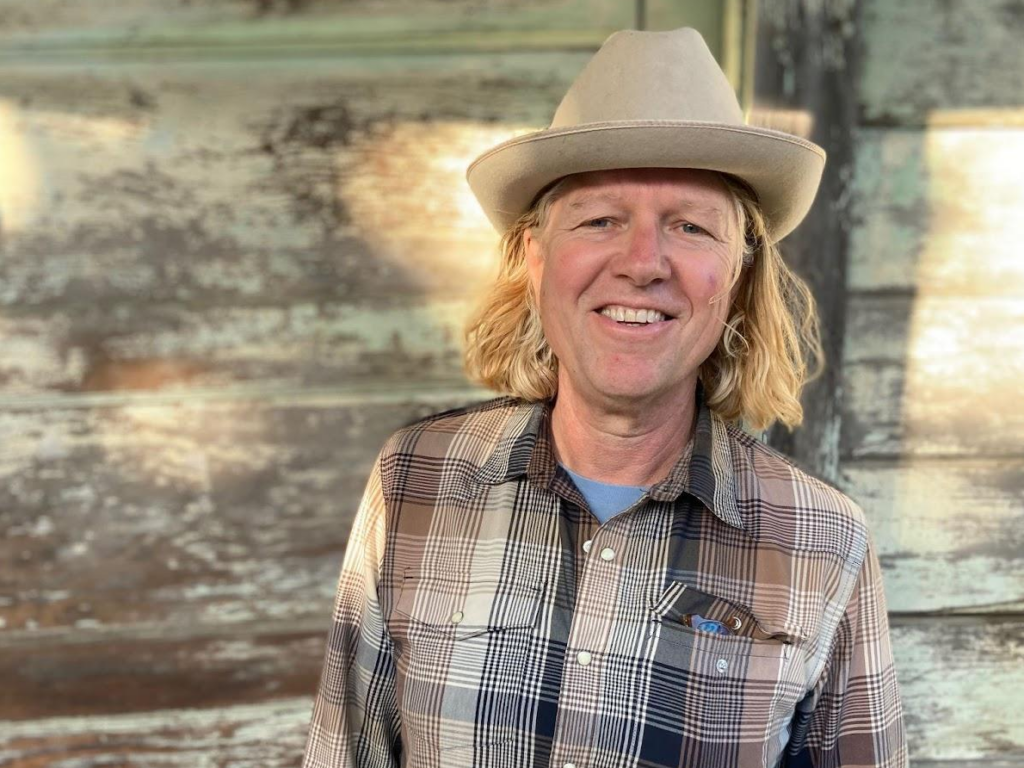
Todd Erlandson
Todd Erlandson is an architect, educator, and founder of March Studio, a Los Angeles-based architecture practice focused on community-centered design. His work explores how places can strengthen connection, belonging, and everyday life, with projects ranging from schools and community spaces to healthcare and nonprofit organizations. He is particularly interested in how design, observation, and shared process can help people better understand the places they inhabit and imagine meaningful forms of improvement.
Todd has taught architecture and design studios at Tulane University, Woodbury University, and most recently at Deep Springs College, where students collaboratively designed and built a small structure in response to place, craft, and community. His teaching emphasizes curiosity, attentiveness, making, and the belief that meaningful learning often begins by slowing down and noticing what already exists. At Outer Coast, he looks forward to exploring how observation, collaboration, and small acts of making can deepen our relationship to Sitka and one another.
Outside of work, Todd enjoys traveling, spending time outdoors, and slowly repairing and tinkering with a small cabin on the Pacific coast of Mexico.